Generators
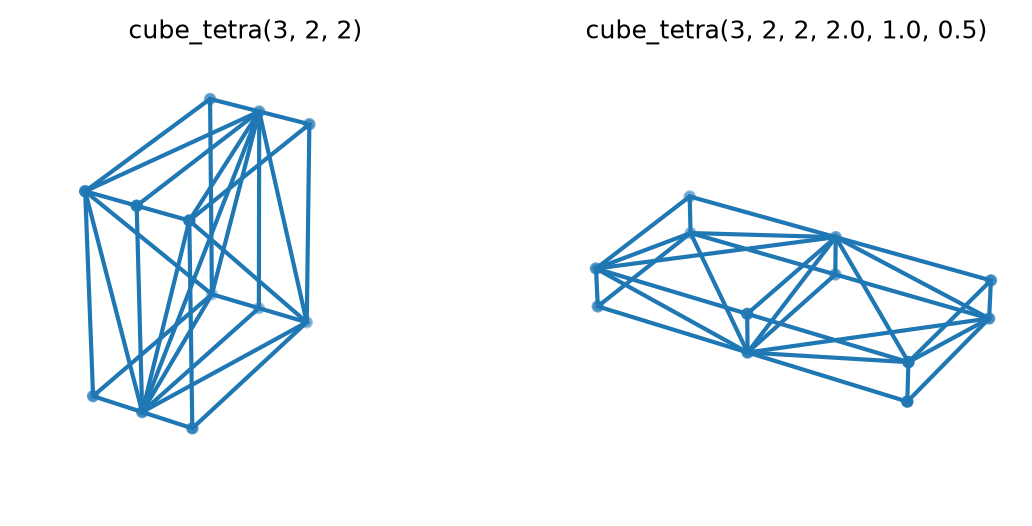
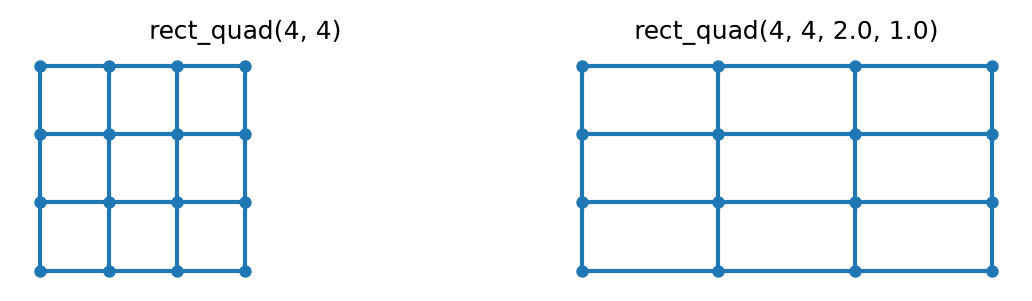
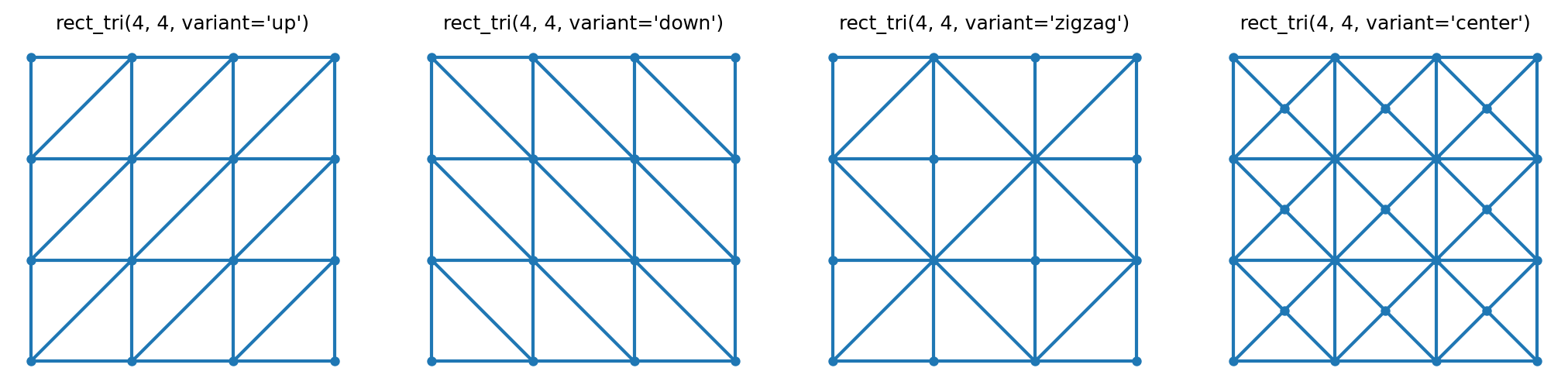
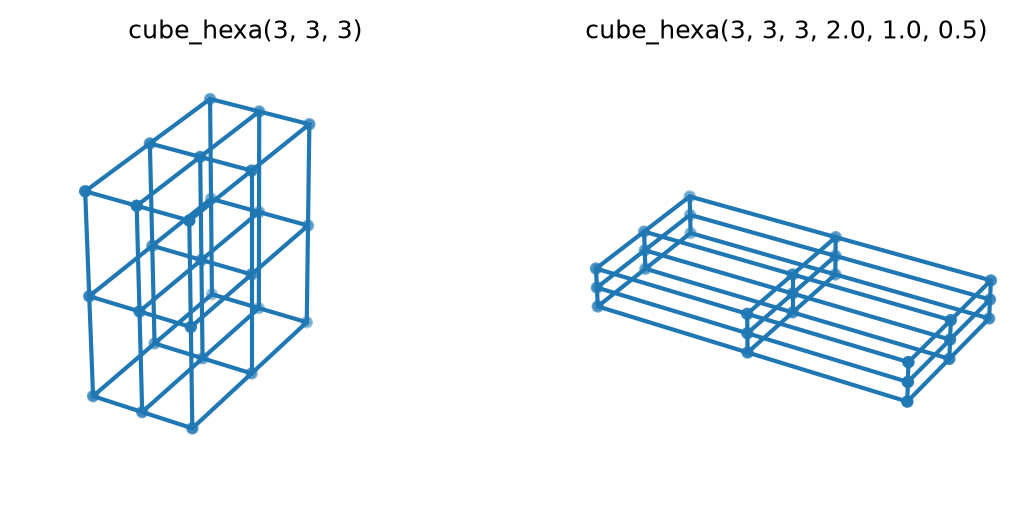
Each generator takes the number of grid points per axis followed by the extent of the domain, and places the nodes on a regular grid over that domain. The figures below pair the default unit domain with one of explicit lengths, drawn at the same scale.
torchfem.mesh.rect_quad(Nx, Ny, Lx=1.0, Ly=1.0)

Generates a structured quadrilateral mesh on a rectangle.
Parameters:
-
Nx(int) –Number of grid points along the x-axis.
-
Ny(int) –Number of grid points along the y-axis.
-
Lx(float, default:1.0) –Total length of the rectangle along the x-axis (default 1.0).
-
Ly(float, default:1.0) –Total length of the rectangle along the y-axis (default 1.0).
Returns:
-
Tensor–A tuple of (nodes, cells):
-
Tensor–- nodes: Node coordinates as a tensor of shape (num_nodes, 2).
-
tuple[Tensor, Tensor]–- cells: Quadrilateral element connectivity as a tensor of shape (num_quads, 4).
torchfem.mesh.rect_tri(Nx, Ny, Lx=1.0, Ly=1.0, variant='zigzag')

Generates a structured triangular mesh on a rectangle.
Parameters:
-
Nx(int) –Number of grid points along the x-axis.
-
Ny(int) –Number of grid points along the y-axis.
-
Lx(float, default:1.0) –Total length of the rectangle along the x-axis (default 1.0).
-
Ly(float, default:1.0) –Total length of the rectangle along the y-axis (default 1.0).
-
variant(Literal['up', 'down', 'zigzag', 'center'], default:'zigzag') –Triangulation. Options are 'up', 'down', 'zigzag', and 'center'.
Returns:
-
Tensor–A tuple of (nodes, cells):
-
Tensor–- nodes: Node coordinates as a tensor of shape (num_nodes, 2).
-
tuple[Tensor, Tensor]–- cells: Triangle element connectivity as a tensor of shape (num_triangles, 3).
torchfem.mesh.cube_hexa(Nx, Ny, Nz, Lx=1.0, Ly=1.0, Lz=1.0)

Generates a structured hexahedral mesh on a cube.
Parameters:
-
Nx(int) –Number of grid points along the x-axis.
-
Ny(int) –Number of grid points along the y-axis.
-
Nz(int) –Number of grid points along the z-axis.
-
Lx(float, default:1.0) –Total length of the cube along the x-axis (default 1.0).
-
Ly(float, default:1.0) –Total length of the cube along the y-axis (default 1.0).
-
Lz(float, default:1.0) –Total length of the cube along the z-axis (default 1.0).
Returns:
-
Tensor–A tuple of (nodes, cells):
-
Tensor–- nodes: Node coordinates as a tensor of shape (num_nodes, 3).
-
tuple[Tensor, Tensor]–- cells: Hexahedral element connectivity as a tensor of shape (num_hexes, 8).
torchfem.mesh.cube_tetra(Nx, Ny, Nz, Lx=1.0, Ly=1.0, Lz=1.0)

Generates a structured tetrahedral mesh on a cube via splitting hexahedra into five tetrahedra each. The splitting alternates between two different patterns in a checkerboard fashion to improve mesh quality.
Parameters:
-
Nx(int) –Number of grid points along the x-axis.
-
Ny(int) –Number of grid points along the y-axis.
-
Nz(int) –Number of grid points along the z-axis.
-
Lx(float, default:1.0) –Total length of the cube along the x-axis (default 1.0).
-
Ly(float, default:1.0) –Total length of the cube along the y-axis (default 1.0).
-
Lz(float, default:1.0) –Total length of the cube along the z-axis (default 1.0).
Returns:
-
Tensor–A tuple of (nodes, cells):
-
Tensor–- nodes: Node coordinates as a tensor of shape (num_nodes, 3).
-
tuple[Tensor, Tensor]–- cells: Tetrahedral element connectivity as a tensor of shape (num_tetras, 4).
Two neighbouring hexahedra, showing how the split alternates between them: